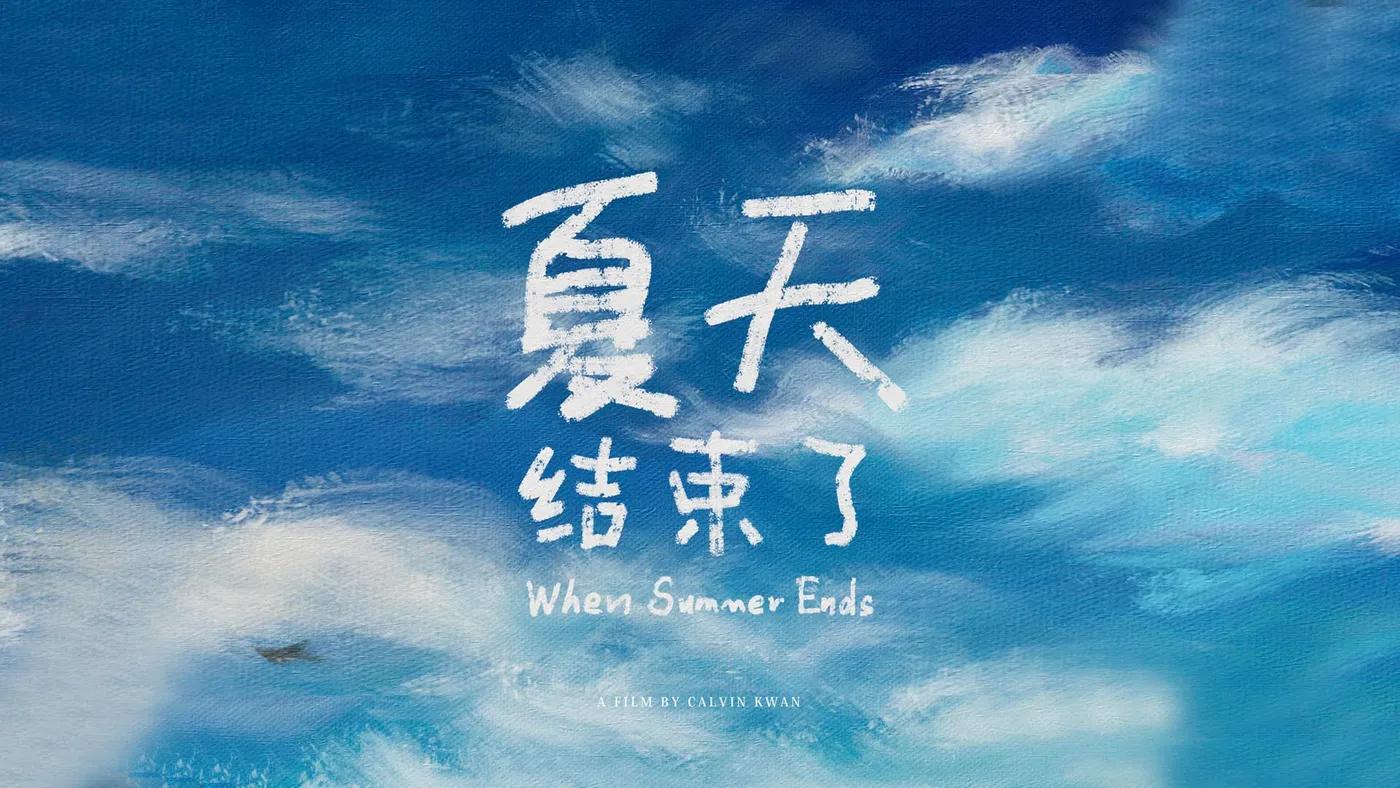
A Conversation with the HKBU MFA Graduation Film "Summer Is Over"
"Some scenes were genuinely very dark—with any other camera you'd have to bring in lights or stylize the look. But the MAVO LF could do it. This really impressed my entire crew. Being that dark and still able to shoot—truly incredible."
Director Guan Zhenhai, "Summer Is Over"
"Summer Is Over" is set against the backdrop of urban village redevelopment in Guangdong, telling the story of a friendship between a girl from out of town and a local boy who spend their days in a village arcade hall. Under a suffocating environment, the two of them face the frustrations of growing up together.
Zhuoyao Why did you choose "Summer Is Over" as your graduation film?
Guan Guan When working on my graduation project, I was really searching for the deepest thing inside me. Only when I find something that genuinely moves me would I choose it as my subject. I initially came up with over ten different scripts covering many topics, but none of them resonated with me strongly—I was dissatisfied with all of them. Eventually, everyone else had submitted their scripts except me, and the pressure was intense. Then one day, I dreamed about a childhood friend I used to play arcade games with. That memory immediately awakened my desire to shoot.
"If we could transcend time and space, transcend distance and class—what would the friendship that emerges look like?"
Following that thought, I arrived at the story of "Summer Is Over"—playing an arcade game together in a place that transcends time and space. You can never say goodbye, but souls can still be connected.
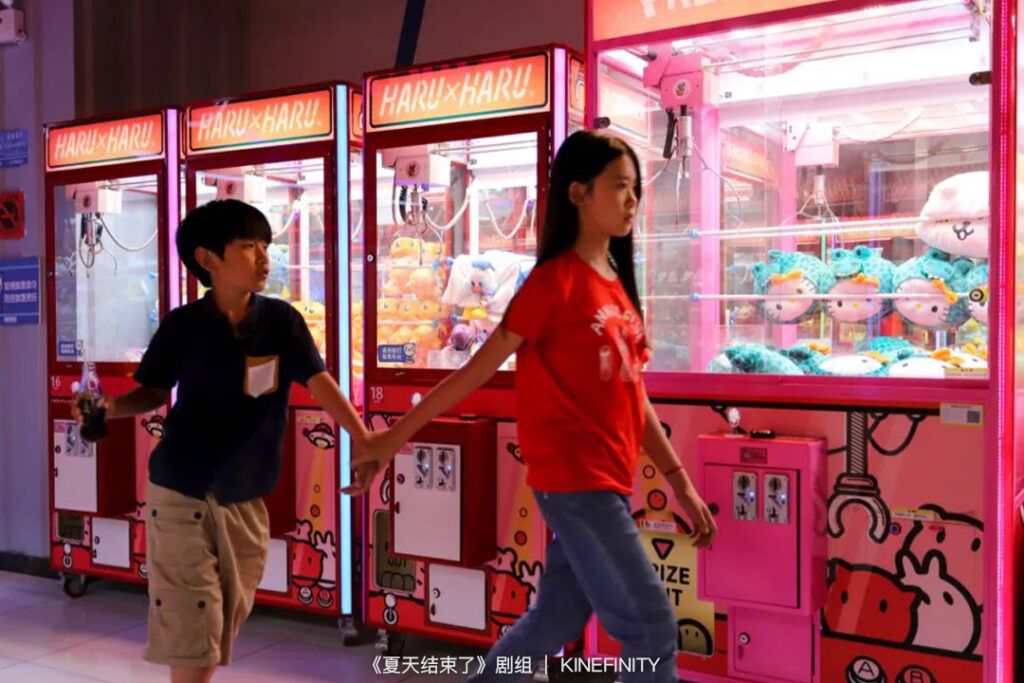
"Summer Is Over" production photos
Zhuoyao Can you talk about the pre-production preparation? Did you encounter any challenges?
Guan Guan When I went to Chaozhou in March for preparation, I was also completely stuck on the script—because I couldn't find a believable location or characters. So I just slowly wandered through the Chaozhou city center. When I walked into a real urban village scheduled for demolition, I found a particularly rundown house that was exactly as I'd imagined. All my emotions suddenly erupted, and I smoothly completed the script following that thread.
However, things went wrong on the very first day of shooting. The homeowners at our primary location had all agreed to let us film, but the village committee said we couldn't shoot in a dangerous building—and they also said the ceremonial ritual we performed before shooting was spreading feudal superstition. So we had to urgently find alternative locations and restart from there.
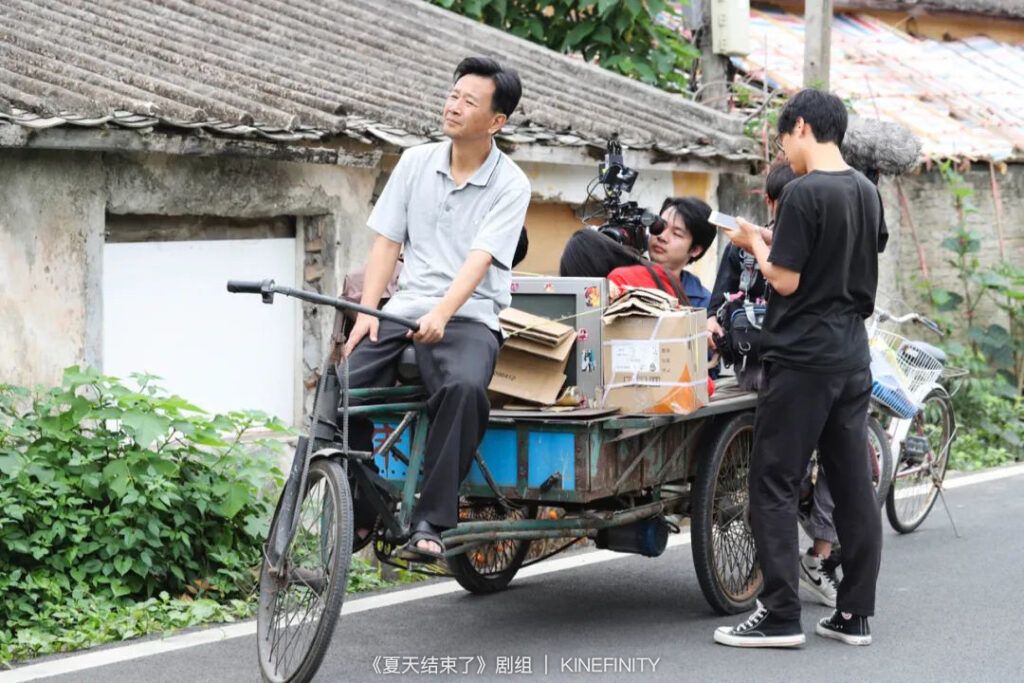
"Summer Is Over" practical location shoot
Zhuoyao Did you and the DP decide on equipment, parameters, and visual style during pre-production?
Guan Guan In my mind, there was only one choice—Kinefinity cameras. First, because the image quality is very refined. Second, because during my MFA studies I had already developed a strong attachment to the MAVO S35—I'd been using Kinefinity cameras for all three years of student film work, I was already in love with the image quality, and its texture had been deeply imprinted in me. Image texture is actually very hard to describe. Every camera has its own texture—whichever you've used most, you become accustomed to its feel. The lenses were Sigma Prime, primarily four focal lengths: 24mm, 35mm, 50mm, and 85mm. The codec was ProRes 4444 XQ.
For the visual style, I always intended to create a period feel, so from initial location scouting through post-production everything was conceived with a film-like quality in mind. Because that era wasn't the smartphone era—it was the early 21st century arcade era—if the images were too polished it wouldn't match the film's texture. So the soft focus and 35mm grain were all considered as part of the overall film approach.
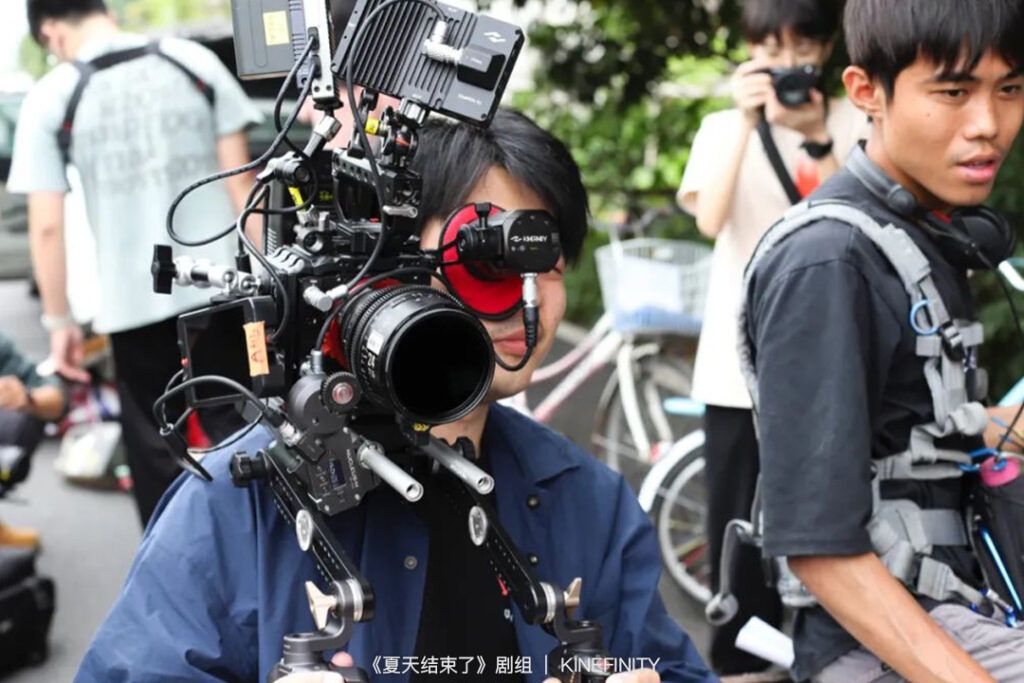
MAVO LF on the set of "Summer Is Over"
Zhuoyao I understand the DP was using the MAVO LF for the first time. How long did it take to get familiar with it?
Guan Guan Less than half a day. Because he had previously used the MAVO S35, once he had the MAVO LF he ran a dual native ISO test—comparing color and noise at ISO 800 and ISO 5120—and found that 5120 was very clean. At first I was genuinely worried about the night scene on the grass, because the main light source was just a butterfly diffusion cloth and a Nanlite Forza 500 providing a base, plus scattered streetlights. But even the darkest scenes were perfectly resolved.
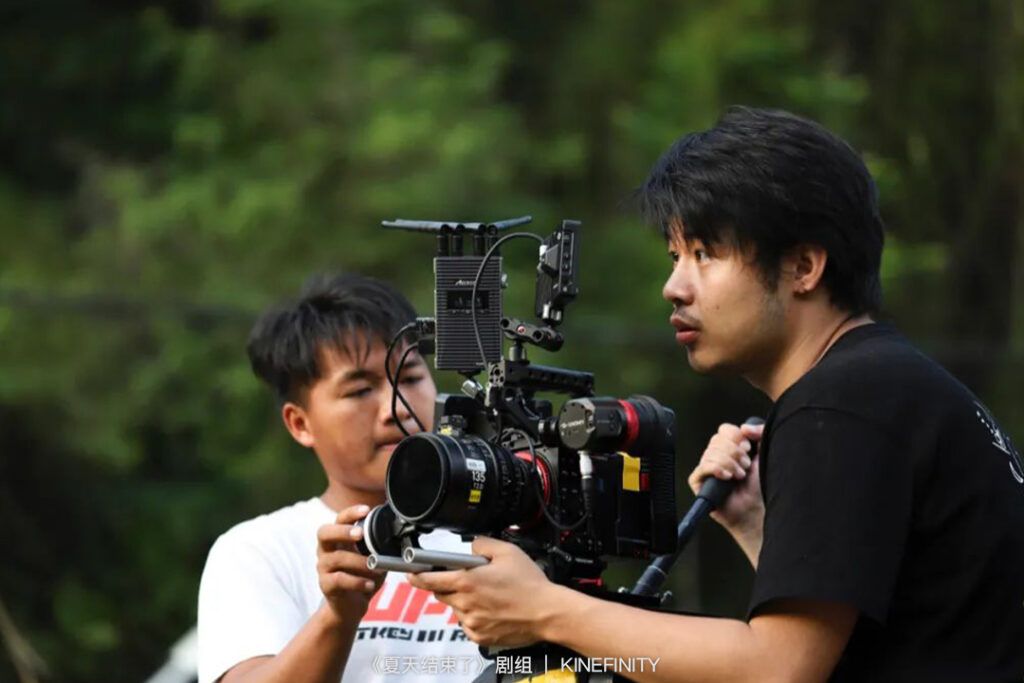
DP Chen Ken with the MAVO LF
Zhuoyao You used both MAVO LF and MAVO S35 as A and B cameras. How was each camera deployed?
Guan Guan The vast majority of shots in the storyboard were captured on the MAVO LF as A-camera—for example the tutoring center and the old house, where the large-format sensor provides a wider field of view. The MAVO S35 was used for improvised shots developed on set, including close-ups and emotionally driven moments. The DP would immediately show me angles as he thought of them, which gave me more options in post and helped me enormously.

Director Guan Zhenhai directing the young actors
Because the shoot was so tight on time, the actors were children, and it was raining, we barely used tracks at all. I kept the B-camera MAVO S35 mounted on a DJI RS 2 as a fixed position, incredibly stable, and the operator could pick it up at any moment to do moving shots. For example, some shots pushing through the fields would normally require building a platform to lay tracks—how much budget would that take!
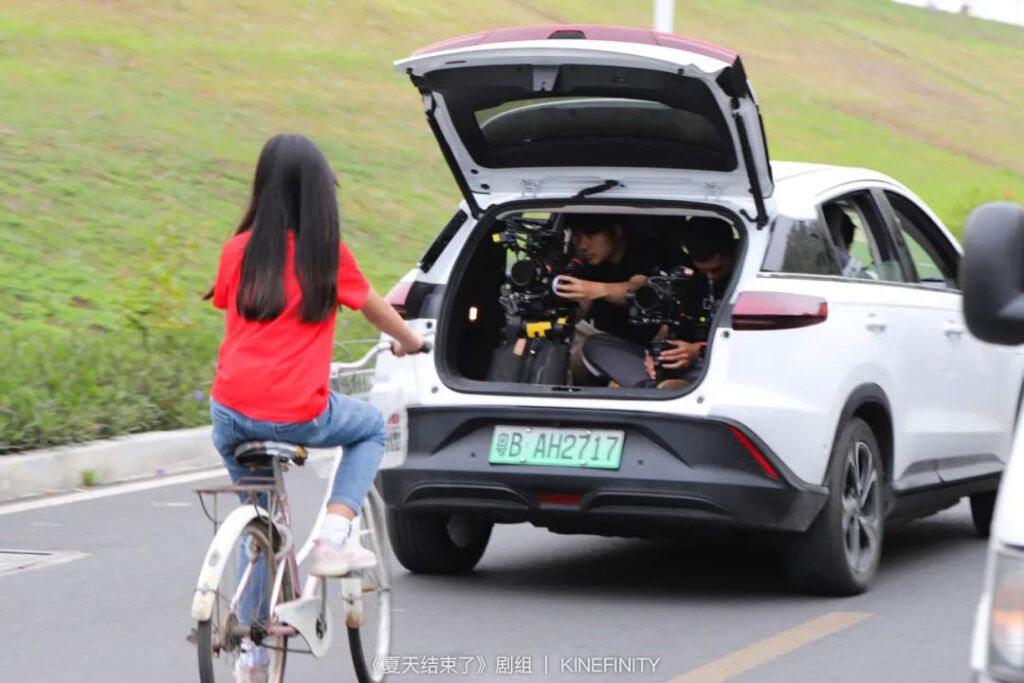
"Summer Is Over" on location
And then for the very first shot in the entire film—normally you'd have a track-and-dolly with a big jib arm behind it, with someone suspended on a dolly moving forward. But we just inverted the RS 2 gimbal and pushed forward, with the background extras retreating as the camera advanced—and it worked beautifully. When the camera is compact, so many more possibilities open up. The fluid, dynamic results you see in the finished film were all achieved by a single person holding a gimbal.
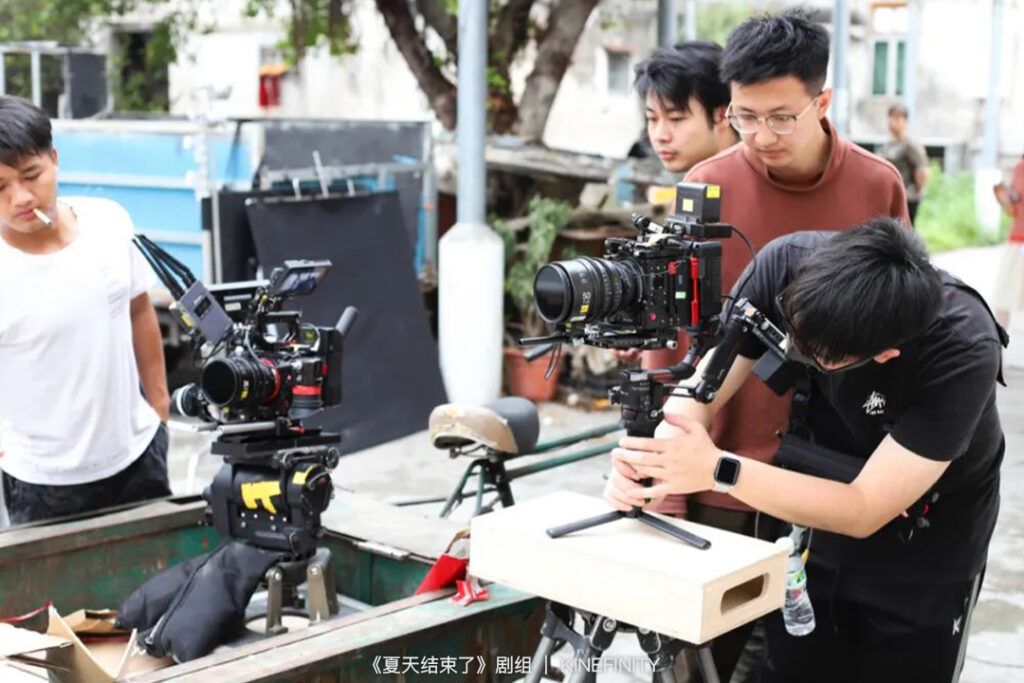
MAVO LF and MAVO S35 dual-camera shoot
Zhuoyao Most of the shoot was in overcast, rainy conditions, and several key scenes were shot in relatively dark environments. How did the cameras perform?
Guan Guan Far beyond expectations. First, under wet and rainy conditions, both cameras performed consistently throughout with no failures—I was genuinely moved. Because the crew's budget and schedule were already very tight, any technical issues would have meant we couldn't finish. Fortunately both cameras were completely reliable: so many location changes, shooting in the rain—both kept rolling smoothly. That gave me real peace of mind.
Second, the MAVO LF's dual native ISO gave me the courage to rework scenes on the fly.
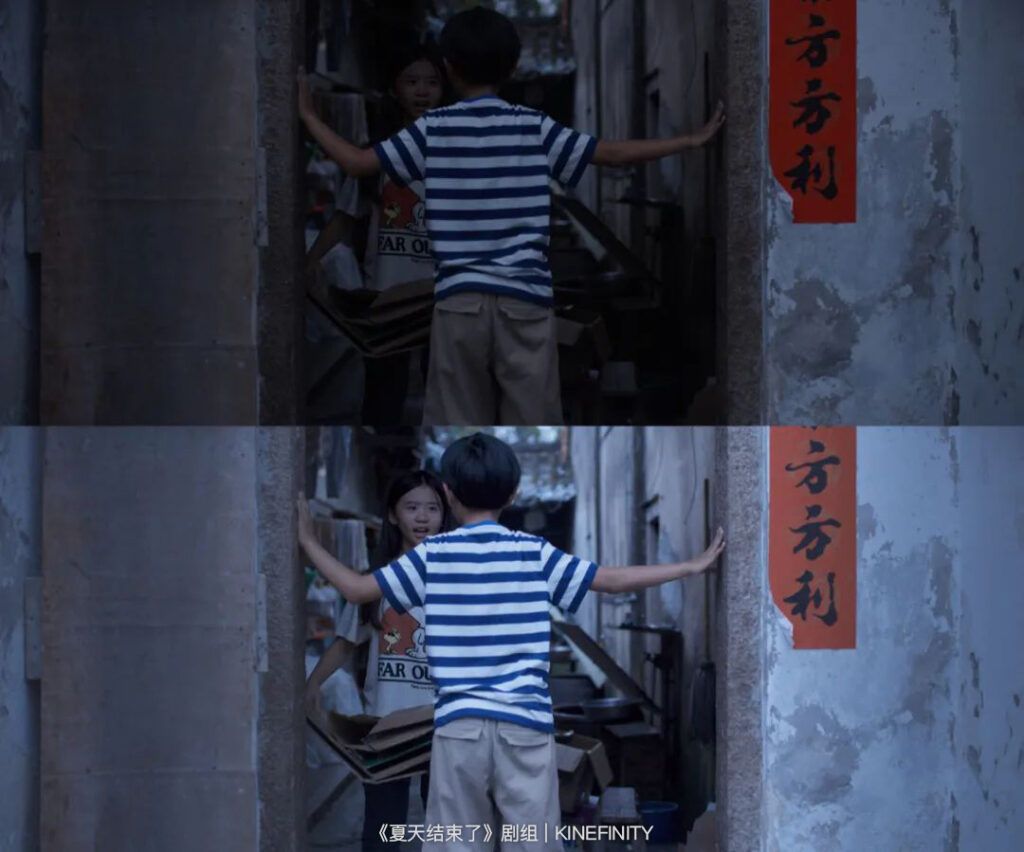
Raw footage vs. finished film comparison
One argument scene was scheduled for daytime, but when the time came it was raining and approaching 6pm. Following the original plan, we'd have to move it to the next day—but our schedule for the next day was already fully packed, and coming back was not an option. So the DP and I discussed it, and we just went for it at ISO 5120. The image was still very clean, and we knew we could pull it back in post.
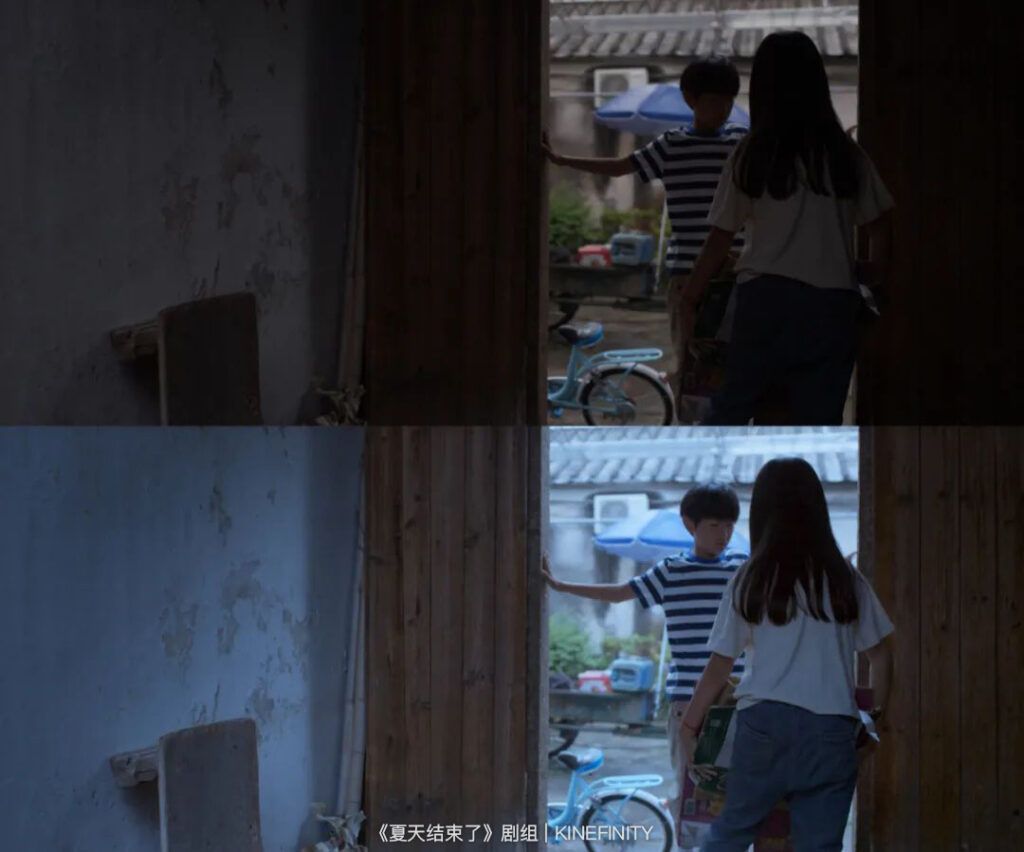
Raw footage vs. finished film comparison
Because we were afraid the rain might get heavier, we couldn't even set up lights—we just shot the entire scene in an hour under the eaves of the doorway. Afterward, we discovered that footage shot near 7pm in almost-dark conditions and footage shot at 5pm could be matched in post, and the two fit together seamlessly. I was genuinely moved. We saved the scene and saved the image.
Zhuoyao Did the finished film match your original vision? Were there any pleasant surprises or moments that left a deep impression?
Guan Guan I'd say it exceeded my expectations. The original footage was already shot on the MAVO LF at ISO 5000-something—just looking at it you can imagine how dark the actual shooting conditions were—that it could be pulled back is truly impressive. We shot 4K HD, and the finished film looks very comfortable and atmospheric.
The MAVO LF's high-ISO capability was the biggest surprise for me. Some scenes were genuinely very dark—with any other camera you'd have to bring in lights or stylize the look. But the MAVO LF could do it—it saved me a lot of time, and this really impressed the entire crew. Being that dark and still able to shoot—truly incredible.
Raw footage vs. finished film comparison
Zhuoyao How was the color grading done?
Guan Guan We decided from the very beginning to go entirely Rec. 709, to ensure color consistency from shooting through post to screening and festival submission. On one hand, our school didn't provide P3-gamut grading equipment; on the other, we thought that after completion the film would only be distributed at festivals and online, so Rec. 709 color space was sufficient.
During shooting we used KineLOG, with an ARRI Log C 709 monitoring LUT. The reason we didn't use Kine's KineLOG-to-709 LUT was consideration for the children's skin tones—Kine's 709 LUT renders slightly deeper, while ARRI's 709 better matched our visual sense. We graded in DaVinci Wide Gamut color space to preserve the footage's dynamic range latitude, with both output and monitoring in Rec. 709 Gamma 2.2.
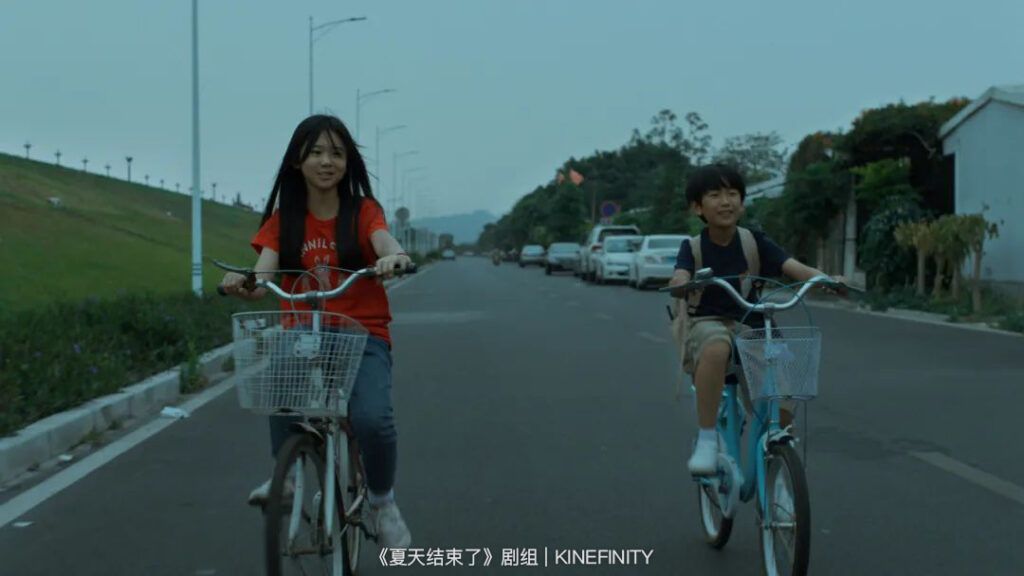
"Summer Is Over" film screenshot
Zhuoyao After working with the LF, how do you see the future of full-frame? In terms of composition and visual design, what do you think is different?
Guan Guan It's very clear—the frame is larger, which gives me a wider field of view. So many narrow spaces can now be shot in practical locations. Like caves or very small rooms—we generally wouldn't use the actual locations for these.
From my perspective as a director, when you shoot in real practical locations, actors enter the performance much more naturally—because they're genuinely immersed in the environment. The dramatic quality and the overall performance are different. When you build a set, the camera positions can be anything you want, but the actors struggle—they're clearly acting.
So strictly in terms of drama, I think full-frame can bring a completely new perspective to location-based filmmaking—allowing you to focus on placing the dramatic experience in its true environment, thereby capturing the most authentic emotions of the actors in the scene. For low-budget productions, student films, or directors who pursue realism, it's a genuinely important revelation.
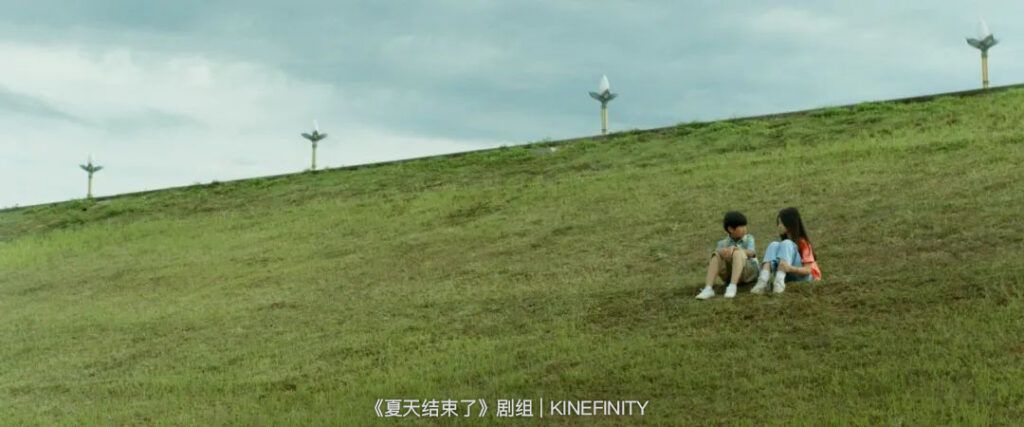
"Summer Is Over" film screenshot
Zhuoyao Finally, can you briefly introduce your school—Hong Kong Baptist University?
Guan Guan Our school places great emphasis on students' holistic development and the diversity of cinema. MFA students have a lot of creative freedom in their filmmaking—there are no restrictions on subject matter, and our supervisors and the school are very supportive of our creative work.
Before shooting a script, we go through a Panel—like pitching a story to a producer—where three or four industry directors are invited to serve as reviewers. Students present a complete script proposal including a script outline, full script, character biographies, creative intentions, artistic references, and even a storyboard. Only after passing this pitch can you begin production. In June there's another screening Panel, where completed works are evaluated on execution, artistic creativity, and overall completeness.
The 2021 Hong Kong Baptist University 16th MFA Youth Film "Reset" Exhibition is currently touring multiple venues on the mainland, and "Summer Is Over" is one of the participating works.
Click the link:"Reset" | Officially Launched! HKBU 16th MFA Youth Film Exhibition, choose the screening venue nearest to you, watch the finished film's authentic and outstanding image quality, and see for yourself whether the MAVO LF is—as the director said—"beyond expectations and deeply impressive."