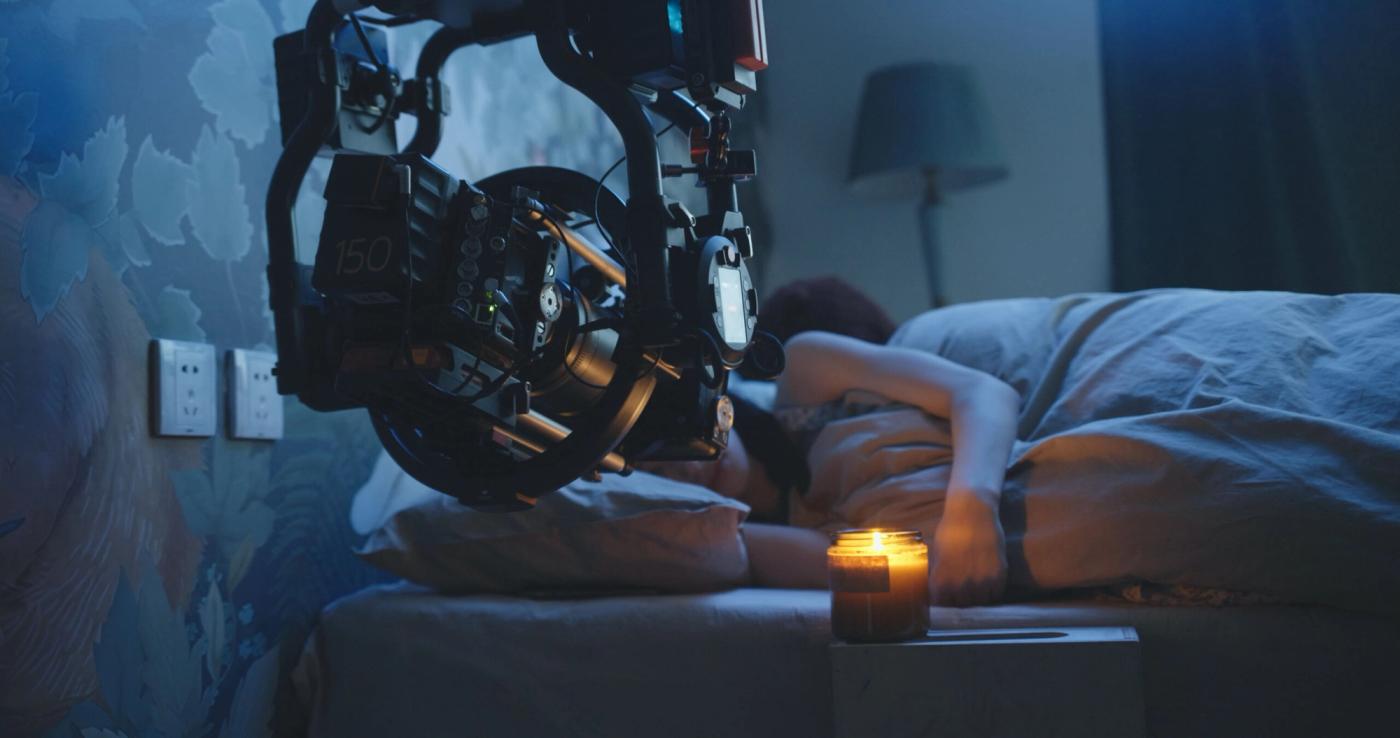
Interview with DP Wan Bocheng
"Wake Up" is the first short film shot after theMAVO Edge 8K's debut, and Edge's powerful performance fully lived up to everyone's expectations. To help you better understand how Edge's new design and improved technology impacted the film's visuals and the cinematographer's experience, we invited Wake Up's DP Wan Bocheng—also a loyal Kinefinity user—to share his thoughts.
Behind the Scenes of Wake Up
Zhuoyao As a loyal MAVO series user, what was your first impression of the MAVO Edge?
Wan BochengFirst, the design—it has a stronger technological feel, less rugged than theMAVO LF, with softer lines. I really like the current size and length—when you mount a battery and lens, the proportions feel very harmonious. The button layout is much more logical: parameters and adjustment buttons correspond one-to-one, and the number of shortcuts has increased significantly, making quick operation very easy. There are also more threaded holes, especially on the sides—you can attach accessories without the side plate, which is great; lighter is always better. Then there's the footage. The combination of Edge's 8K resolution and the Arri Signature Prime's resolving power brought me a huge and astonishing surprise. The first time I saw the footage was on an iMac 5K screen on set—the incredibly clean image captured the actors' performances with an indescribable sense of reality, especially in close-ups, where I could truly feel the actors' emotional nuances in a way I had never experienced in any previous shoot. I believe that even viewers outside the film industry would be able to feel this emotional transmission through the stunning images when watching the 4K version on a big screen.
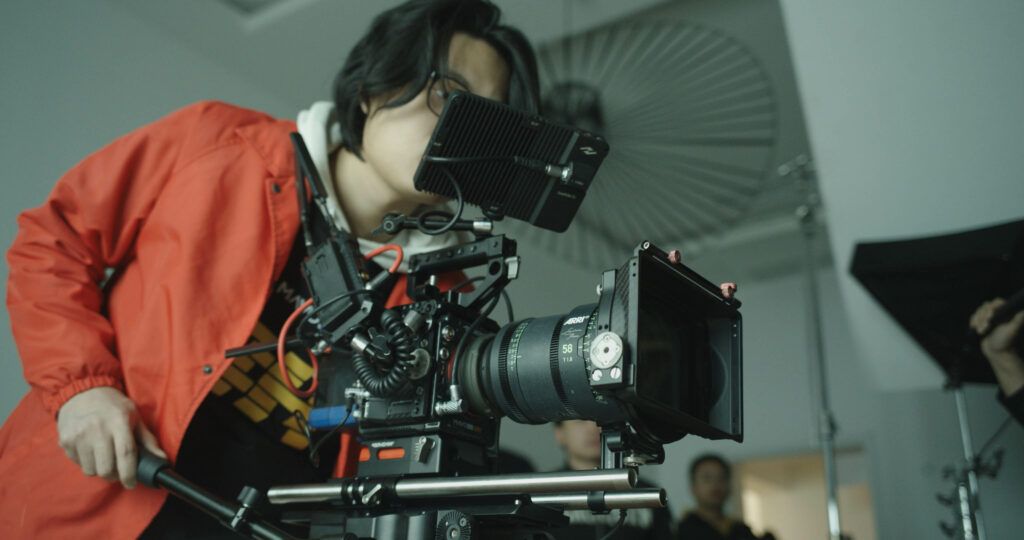
Zhuoyao We're curious about the equipment you used during the shoot and why you decided to pair these with Edge.
Wan BochengThis is a story where reality and dreams interweave—the overall atmosphere should be hazy and surreal. I decided to use a lot of shallow depth of field to convey these qualities. Compared to S35 systems, the MAVO Edge with its full-frame CMOS sensor achieves shallower depth of field at the same focal length and aperture. For lenses, I chose the Arri Signature Prime set—because this story feels very light and soft, I wanted the images to be gentle and natural, and the Signature Prime's T1.8 delivers high-resolution natural images even wide open. Since the girl's emotions change constantly throughout the film, I reflected her emotions through camera movement: for slow, heavy emotions I used the GFM PRIMO and GFM SLIDER; for light and joyful moments I used the Movcam HELM stabilizer. The varied camera movements not only express the girl's different emotional states but also give the images a sense of vitality and a gradual awakening. On top of all this, I used Black Pro-Mist 1/8 and Hollywood Black Magic 1/8 filters as constant companions—to subtly bloom highlights, soften high-frequency detail, and gently reduce contrast, giving the images a sense of lightness.
Zhuoyao As a longtime Kinefinity user, where do you feel Edge has improved compared to previous products?
Wan BochengI used the MAVO LF to shoot most of my graduate school projects. Compared to the MAVO LF, Edge has improved in many ways: built-in electronic ND, carbon fiber exterior, a more logical button layout, more comprehensive and standardized ports, a creative power clip-on module, and higher resolution. Most excitingly, despite all these upgrades, it has maintained a sufficiently compact size and weight.
Zhuoyao During the shoot, what conveniences did Edge bring you?
Wan BochengFor handheld shooting, Edge's high integration delivers outstanding advantages: Edge integrates a V-mount battery plate directly—no need to add one through a cage—which brings much higher usability and agility compared to other brands. The most welcome improvement is finally having a built-in electronic ND. This helps me enormously, because the director I work with regularly prefers a documentary-style approach—she's very focused on capturing the actors' fleeting emotions, and missing a great performance because of an ND filter swap would be devastating for both of us. Edge's stepless electronic ND solves this perfectly. Edge's size and weight are also very accommodating—well-suited for handheld, gimbal, and Steadicam shooting. Its high resolution and large sensor give me more format choices too: in special situations, I'll shoot a wider high-resolution frame and fine-tune the framing and movement in post to get the best result.
Zhuoyao There are many high-contrast scenes in the film—how do you feel about Edge's dynamic range?
Wan BochengEdge maintains excellent shadow performance, and the highlight dynamic range has noticeably improved compared to the MAVO LF. At ISO 800, highlight headroom can reach 6.0 stops. Although its dynamic range distribution differs from some other cameras, once you adapt and develop corresponding exposure habits, you can handle the vast majority of high-contrast scenes.
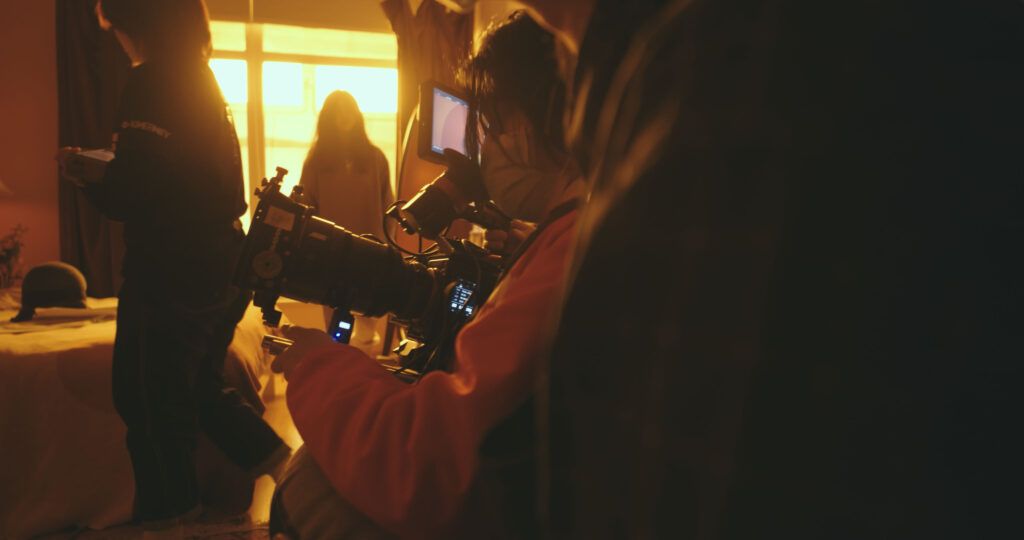
Zhuoyao For you, what is Edge's core advantage?
Wan BochengIf I had to name a core advantage, I'd say color science and high-quality codecs. A camera can have many features and impressive specs, but if the footage doesn't look good, people won't choose it. I've always felt the MAVO series' color is very well-suited for narrative filmmaking, and the MAVO Edge clearly inherits the MAVO LF's color science. Most importantly, the MAVO Edge is the most competitively priced 8K cinema camera on the market. For projects venturing into 8K, Edge is the best choice. It also has unparalleled advantages for 2K or 4K projects, because its lower-resolution options are achieved through oversampling and downscaling—no usable sensor area is lost. And at this price point, no other camera can record Apple ProRes 422HQ and ProRes 4444/XQ internally—codecs that everyone knows are excellent with very mature post-production workflows.
Zhuoyao Finally, please briefly describe your overall impression of the MAVO Edge.
Wan BochengOverall, Edge is an extremely comfortable and utterly lovable cinema camera. Image quality: perfect skin tones, smooth and natural highlight roll-off, sharp yet natural images. Usability: a highly integrated yet lightweight body that effortlessly handles any shooting situation. I really can't wait to use the MAVO Edge on my next project!
Thank you to DP Wan Bocheng for his answers! That concludes this interview—we hope it has been helpful to all friends interested in Kinefinity.