Interview with DP Yu Gang of "Star Feelings"
"Shooting with alternating lights in an extremely dark environment puts severe demands on the camera's performance. As it turned out, this was absolutely no challenge for the MAVO Edge 8K—it delivered perfect results with complete ease."
Time Coordinates, DP Yu Gang, "Star Feelings"
For audiences, a sci-fi film is a feast of imagination; for directors, it's a process of using real industrial technology and scientific theory to reconstruct a dazzling virtual world. As Chinese filmmakers continue to develop the genre, domestic science fiction pays increasing attention to technical development and narrative exploration.
The domestic sci-fi film "Star Feelings" was born from a virtual production system in which Chinese-made hardware accounts for over 90% of the components, shot entirely using the Chinese-made cinema cameraMAVO Edge 8K. Let's step behind the scenes of "Star Feelings" with DP Yu Gang.
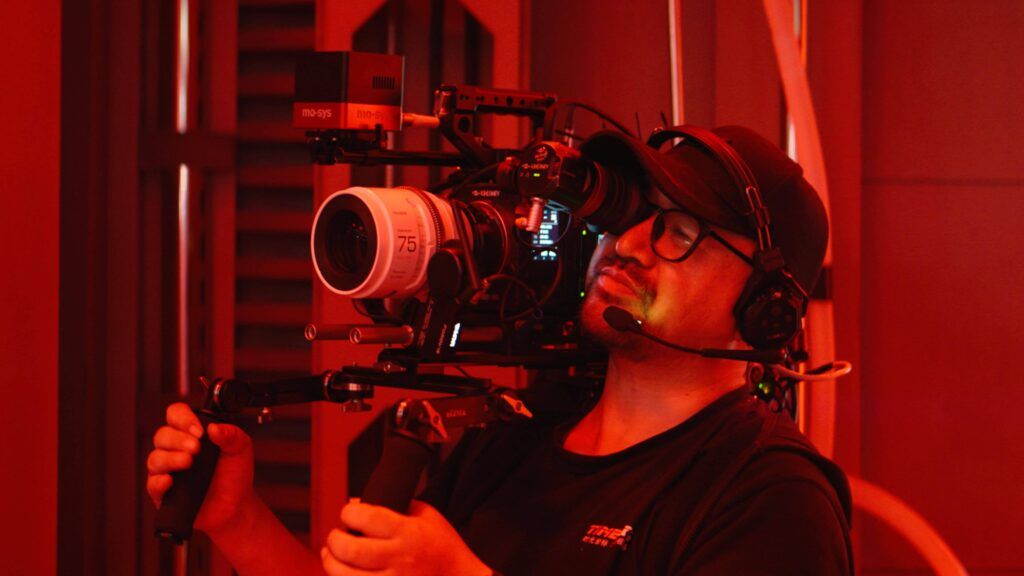
DP Yu Gang with the MAVO Edge 8K
Yu Gang is a sci-fi director, cinematographer, and producer—co-founder of Time Matrix, graduate of Zhejiang University of Media and Communications. In 2014 he served as executive director on "You Are the Apple of My Eye" (同桌的你); in 2019 he served as a second-unit director on "The Wandering Earth." He serves as executive producer of the sci-fi short "Human Parcel Delivery" (人体快递) and as DP of the sci-fi short "Star Feelings" (星绪).

Zhuoyao What brought you to creating this sci-fi film?
Yu Gang Our Time Coordinates company, together with the China Film Science and Technology Research Institute, built a virtual production studio at Wuxi Hollywoo—the Wuxi National Digital Film Industry Park. The design, installation, and calibration were all completed by Time Coordinates' virtual production department. Everyone agreed that the best way to validate a system is through practical use, so we initially wanted to shoot a single-take short first.
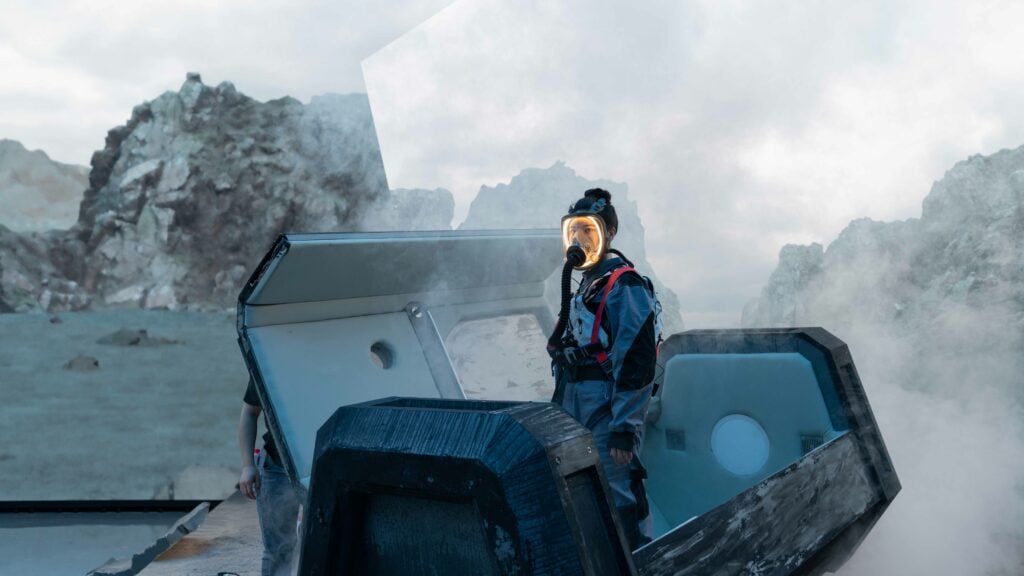
LED virtual screen and space capsule
Yu Gang Before shooting, I decided to establish the scenes first. Virtual production is especially well-suited to science fiction, so we wanted to create a scenario spanning from outer space all the way to an alien world. After confirming the theme, we ran a pre-visualization shoot primarily to work out the camera choreography. But when I arrived at the Wuxi set, I found the motion control system was one segment short—many of the planned moves were impossible to execute. And the space capsule prop we had designed needed a mechanical structure that could rotate, but there wasn't enough time to build it.So we ultimately decided to step back and meet proper film production standards, making a more complete sci-fi short—and that's how this film was born.
Zhuoyao After deciding on the subject matter, how did you design and plan the shoot?
Yu Gang Science fiction feels quite distant to general audiences. If you just pile on high-concept theory and viewers leave without understanding it, that's a very unfriendly sci-fi work. So "Star Feelings" has a relatively simple story that most people can follow immediately, but there are subtleties that reward closer viewing. For example, we embedded visual references to classic sci-fi films like Star Trek, Interstellar, and 2001: A Space Odyssey in the film's cinematographic language.
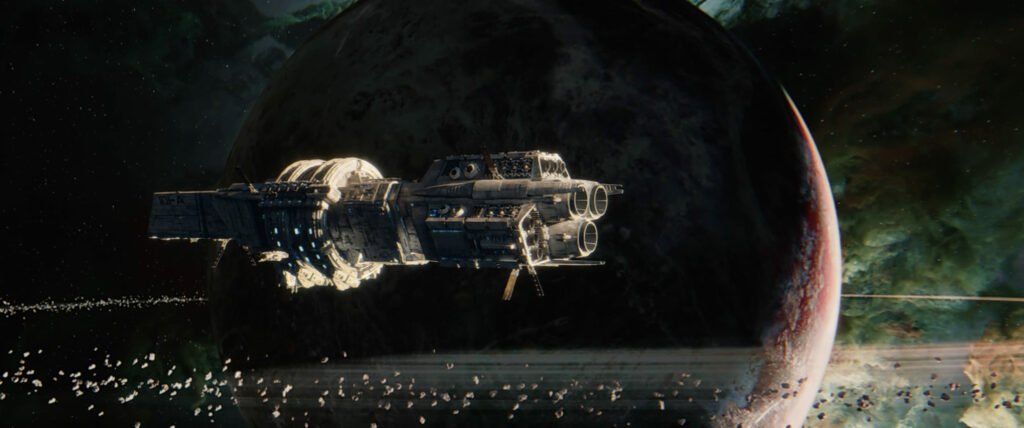
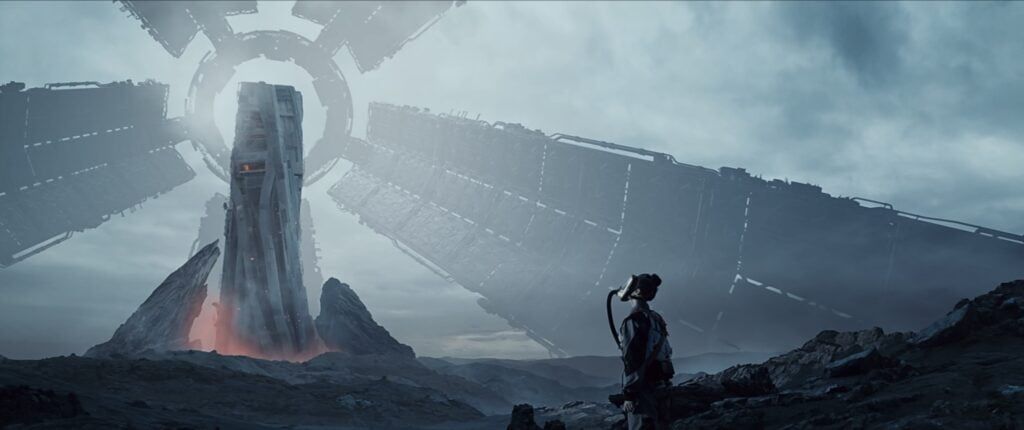
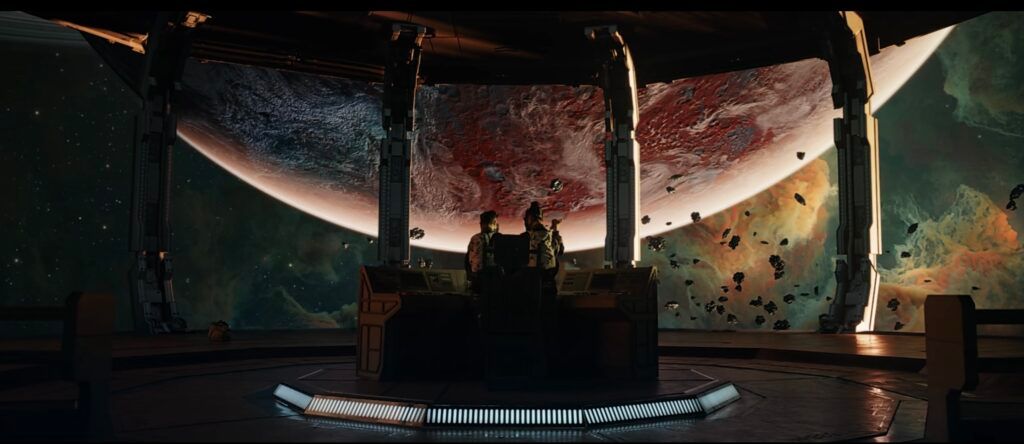
"Star Feelings" frame captures
Yu Gang The core of this story isspace exploration. The female protagonist's father disappeared years ago during a space voyage. To follow in her father's footsteps, she sets off on an extraordinary journey to find him.As the story unfolds, the audience will experience breathtaking interstellar wonders.
Zhuoyao What cutting-edge technology does the film employ? What are the highlights?
Yu Gang The virtual production studio that our Time Coordinates virtual department designed and built is officially called the 5G Smart Virtual Production Joint Laboratory. It has a few key concepts: one isAIGC(AI-generated content)—so our creative work had to incorporate AI; another is5G—demonstrating how technological advancement enormously empowers creative work, through things like game AR and artificial intelligence. So this was actually a thematic production. We chose to shoot with the MAVO Edge 8K because the LED virtual screen we used is currently the highest-spec available domestically,and the MAVO Edge 8K can meet the demands of high-spec shooting—which was also a test for our LED screen.

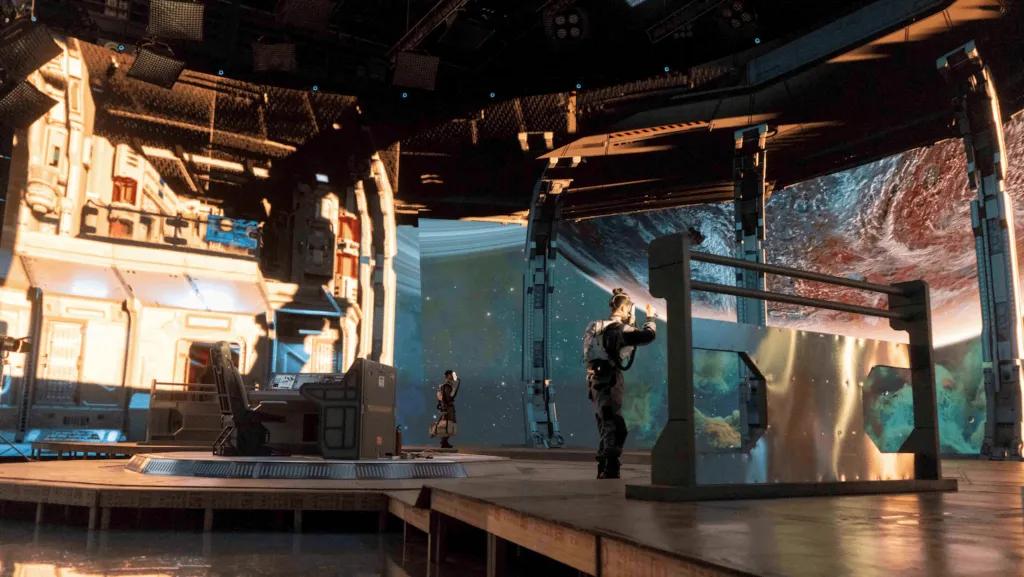
Virtual production on set
Zhuoyao Had you previously used aKinefinitycinema camera? Why did you choose theMAVO Edge 8Kfor this shoot?
Yu Gang Two years ago we used a Kinefinity cinema camera for an LED virtual production shoot, and the experience made a very deep impression on me.
The reason for choosing the MAVO Edge 8K this time was to let everyone see how LED virtual production performs at 8K resolution.The LED screen used this time is a Chinese-made screen with Hollywood certification—a first-class standard in image quality, motion, color, and everything else. But can it be used to make a film? Can footage shot at a large aperture revealsufficient detailon a large cinema screen? Will the LED screen produce moiré? Will there be color banding? These are things every film director and cinematographer cares deeply about.
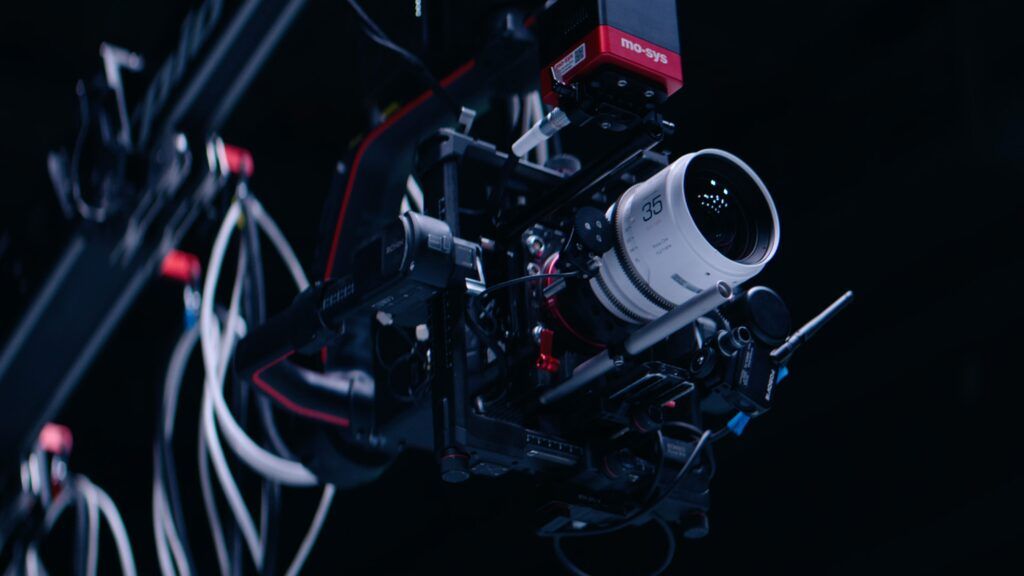
MAVO Edge 8K with mo-sys motion control
Yu Gang If you use a 2K camera, as long as the focus isn't on the screen, moiré is very difficult to produce no matter how you shoot. But 2K resolution is a bit outdated for feature film work now. So we decided to go straight to the MAVO Edge 8K—test it at 8K and see if moiré appears. If a camera of this high precision can still hold up, that proves the entire virtual production system has truly reached the required standard and is capable of shooting science fiction features. That's why I chose the MAVO Edge 8K.
And I've always been a big fan of Kinefinity cinema cameras. These past two years I've watched Kinefinity cameras continuously improve—today's MAVO Edge is excellent in both convenience and stability.
Zhuoyao What challenges did you encounter during the shoot?
Yu Gang This film includes an enormous variety of scenes—lighting transitions, shifts between virtual and real elements, and more. One inherent challenge in LED virtual production is whether the lighting within the screen can be synchronized with the real practical lights on set. So there's a scene with rapidly flashing red lights specifically designed to test this. The red lights flash inside the screen, and matching red lights flash outside the screen. We used Litegear and Aputure fixtures, and after integrating them with our screen system we were able to achieve synchronized control—achieving true lighting unison.
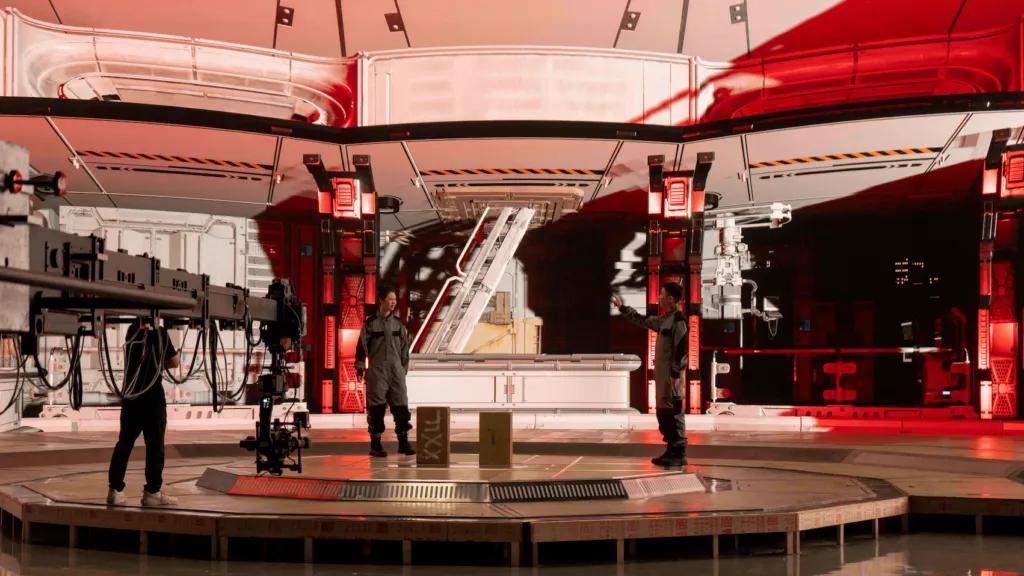
Virtual production on set
Yu Gang But this kind of scene change is a severe test for the camera's performance.Shooting with alternating lights in an extremely dark environment—whether the camera can handle such conditions, whether the low-light performance is sufficient—this is also a challenge.As it turned out, this was absolutely no challenge for the MAVO Edge 8K—these scene changes were shot with complete ease and perfect results.
Zhuoyao How were the virtual screens and practical props integrated?
Yu Gang The hardest part of LED virtual production is combining practical and virtual elements.There's a scene where the protagonist runs through a corridor. Most of the corridor is actually virtual, displayed through the LED screen—only the two falling shots are practical.
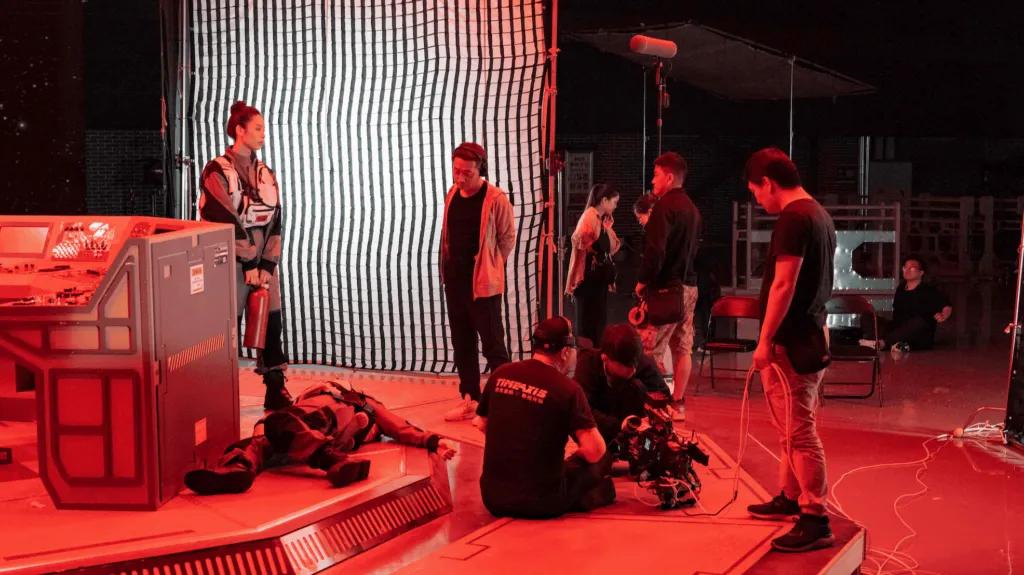
MAVO Edge 8K filming
Shooting purely virtual scenes is actually straightforward, but the parts where the camera is close to practical elements—where people are touching things—cannot be replaced by the LED screen. In the corridor scene, the two close-up shots used real practical lights, while the lights in the distance were virtual lights displayed through the LED screen. After editing, you can't tell the difference in the finished film, because the LED screen displays HDR high-dynamic content.
Its peak brightness reaches 1800 nits, so the virtual engine lights displayed inside it are just as bright as the real practical lights outside, creating a high-contrast environment that allows them to integrate with practical elements. Some lower-quality screens have inaccurate color, and to avoid moiré you have to shoot at a very large aperture—which blurs the background badly and makes it immediately obvious to audiences that it's fake.
So for most of this shoot, I avoided that situation and only opened the aperture to T4 or even T5.6.The smaller the aperture, the more detail visible on the screen—and the more the MAVO Edge 8K can capture. This kind of shooting, very close to how the human eye perceives things, can meet the standard for large cinema screens.
Zhuoyao What advantages did the MAVO Edge 8K demonstrate in virtual production?
Yu Gang I'm very particular about quality control,and the MAVO Edge 8K never had a single issue throughout the entire shoot—extremely reliable.Also, the MAVO Edge 8K's built-in electronic ND is very convenient to use. Normally when shooting indoors, you might say there's no need for ND—but on this shoot, even though we were indoors, I used ND extensively, because the LED virtual screen's brightness is very high.
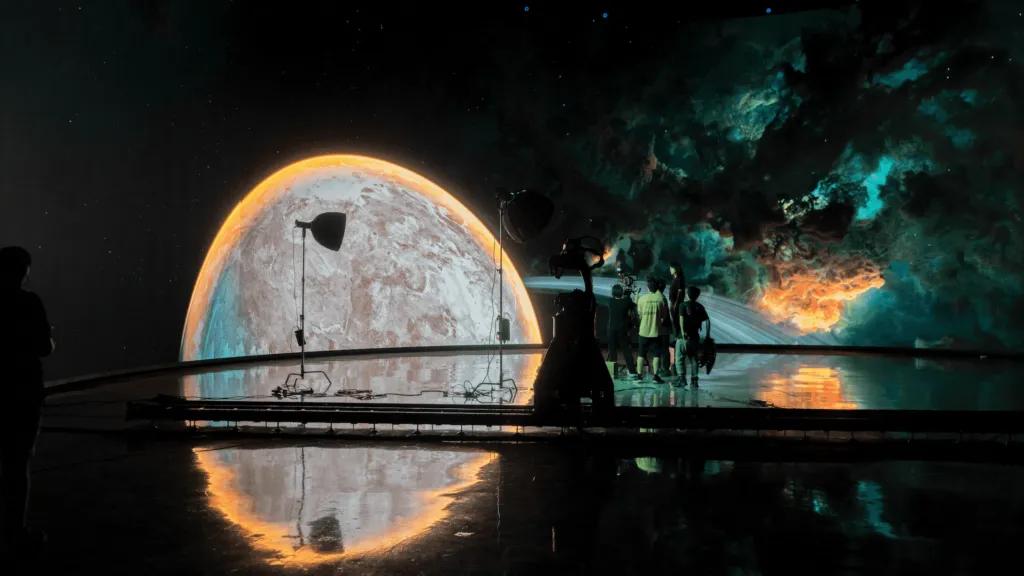
Virtual production on set
Yu Gang One of the common mistakes in virtual production is reducing the screen brightness because it's too bright, then raising the camera's ISO—which narrows the dynamic range latitude of the screen's color gradation. In reality it's the same as shooting a night exterior: for night shooting, you add lighting to illuminate the environment and then use ND to reduce the sensitivity—working backwards. So that's what we did here too: we raised the ND filter level, starting from 0.6. On set everyone felt it was extremely bright, but what I was seeing through the camera and monitor was actually a darker image—which ensures the footage has relatively less noise. After noise reduction in post, the footage was perfect.

Zhuoyao After completing the entire film, what are your overall impressions and feedback on the MAVO Edge 8K?
Yu Gang Kinefinity cameras all have exceptional price-to-performance ratios. The rental cost for other brands with comparable specs is enough to buy two MAVO Edges outright—a completely acceptable cost. Half-joking, I'd even be comfortable mounting it somewhere risky—even in an explosion shot—with full confidence.
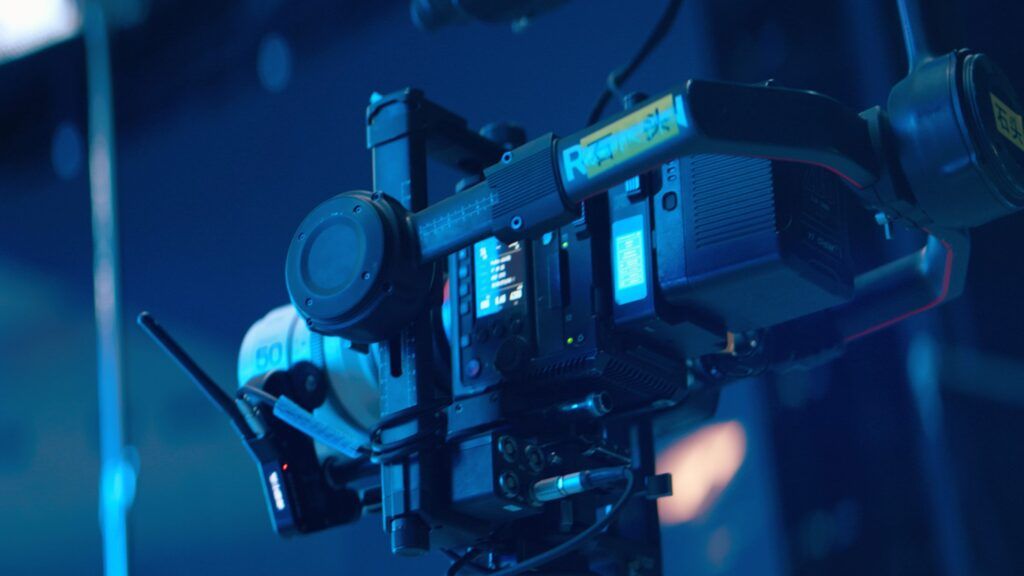
MAVO Edge 8K filming
Yu Gang When evaluating a camera, you can't just look at the unit price—you also need to consider the accessory ecosystem. I think one of the best things about Kinefinity cinema cameras is the ability to use standard SSDs. That's critically important. I had four SSDs ready and could shoot freely for an entire day, in any configuration I wanted—something previously unimaginable.
And the KineMAG Nano transfers footage via the card body's Type-C interface at speeds up to 10Gbps—extremely fast. Backing up 8K footage has much more breathing room.
The MAVO Edge 8K's built-in features are also very comprehensive—for example,wireless remote control—which solves many practical operational challenges. My overall feeling after using it is that it's genuinely very convenient. On top of that, the body is very lightweight, making it easy to strip down and mount on a gimbal. This entire shoot we used it on an extendable jib arm with a remote head throughout—extremely convenient.
Zhuoyao Were there any particularly memorable moments during the shoot?
Yu Gang The MAVO Edge's low power consumption left a particularly deep impression on me. The MAVO Edge 8K with a 200Wh battery on a jib arm can run for 4–5 hours—the shooting process was very comfortable, and we only swapped batteries twice in a full day.Some cameras consume power so aggressively that even a large 200Wh battery might only last 2–3 hours—the constant battery anxiety is genuinely stressful.
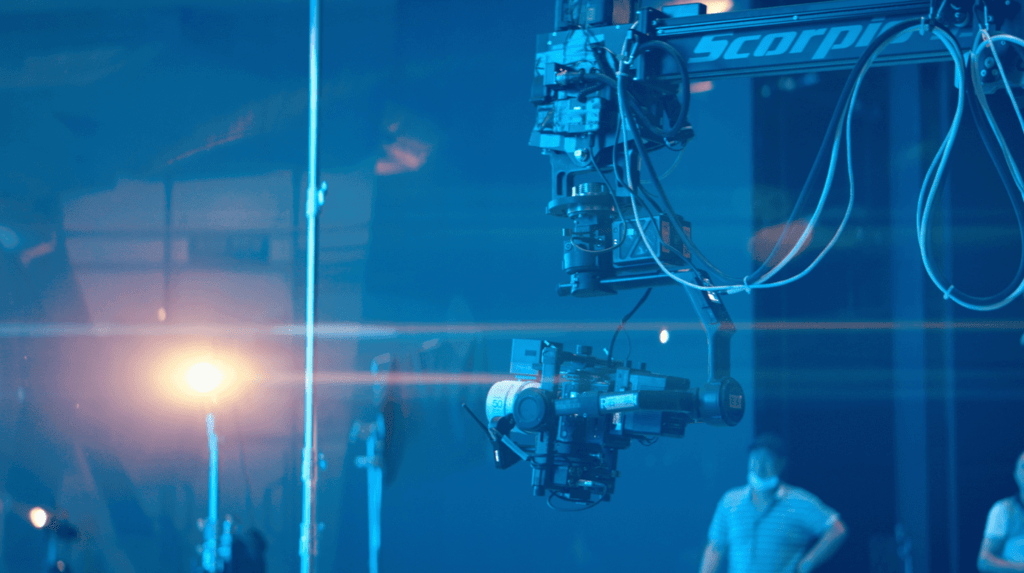
MAVO Edge 8K filming
Yu Gang For even smaller productions, the MAVO Edge is even more suitable—you don't need to prepare as many batteries on set, and there's less swapping back and forth. Don't underestimate these 'small things'—they add up to a slight efficiency improvement each day, which compounds into a significant overall gain. All of that translates to money, in every aspect. For low-budget productions, buying a Kinefinity camera is definitely more economical than renting—especially for long-term use, when you amortize the cost you'll find it's remarkably affordable.
Zhuoyao How do you see the role of Chinese-made camera equipment in shooting Chinese science fiction?
Yu Gang Most of the equipment in "Star Feelings" is Chinese-made. I hope Chinese-made equipment can earn widespread recognition—proving that Chinese people are fully capable. I'm someone who loves innovation, and I enjoy using all kinds of new cameras.Kinefinity, as a leader among Chinese-made cameras—one could even say the pride of Chinese manufacturing—I'm very happy to use the MAVO Edge 8K to make films.In the film, the Edge 8K was paired with a Viltrox EPIC anamorphic adapter,with extensive 1.33× anamorphic shooting. On a true 8K display screen, the final result would absolutely be extraordinary.
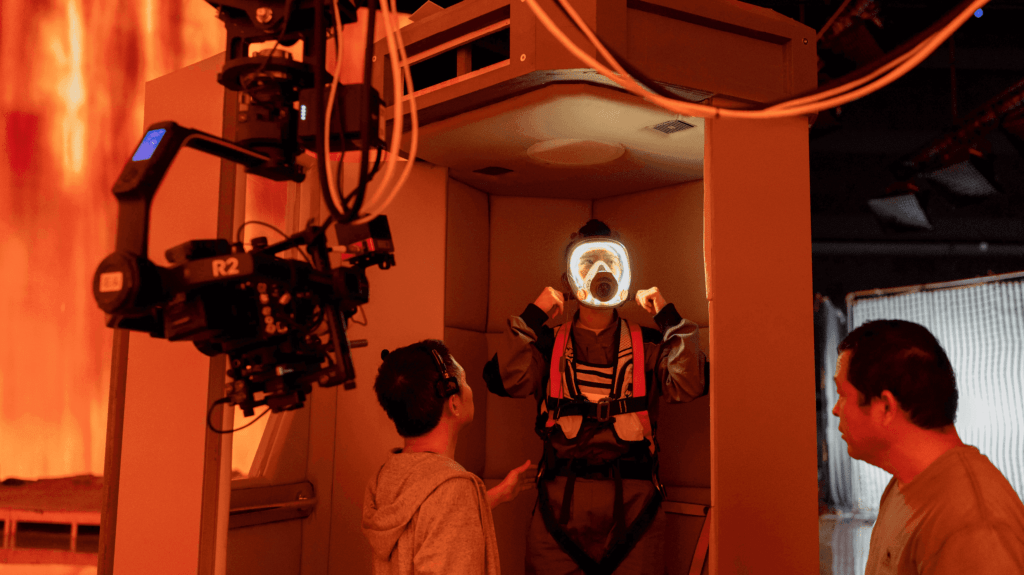
Virtual production on set
Yu Gang The problem Chinese science fiction faces right now isn't creativity or development—that's not the issue. The hard part is execution.How do we use affordable, practical methods to produce all kinds of Chinese science fiction films? That's the most important question.
LED virtual production is a crucial element of sci-fi filmmaking—it solves many scene challenges that previously required enormous budgets, and using Chinese-made camera equipment is all part of solving the affordability problem. We're working hard to promote it, so that cinematographers, directors, and producers can all understand the benefits of LED virtual production. Regarding Chinese-made camera equipment,I hope more people come to know about the MAVO Edge 8K—this exceptional Chinese-made cinema camera—so together we can continue to build China's science fiction film industry into something even greater.
"I've always been a big fan of Kinefinity cinema cameras. These past two years I've watched Kinefinity cameras continuously improve—today's MAVO Edge is excellent in both convenience and stability."
Yu Gang, DP of "Star Feelings"
Virtual production technology has freed cinema from the limitations of physical space, further expanding the frontiers of science fiction filmmaking—and Chinese filmmakers have never stopped exploring its possibilities. Kinefinity is honored to stand shoulder to shoulder with so many filmmakers, contributing to Chinese sci-fi virtual production!