CCTV Cinematographer Shi Wenlong's Notes
"Shaolin Three-Section Staff" is a humanistic documentary episode produced by CGTN China International Television's "1.3 Billion" program. This article is the cinematography notes of Central Television Tower cinematographer and DP Shi Wenlong, describing how the MAVO LF helped complete a high-quality shoot efficiently in challenging conditions—covering equipment selection, crew configuration, and shooting environment. It also documents a memorable incident during equipment preparation.
Shaolin Three-Section Staff: Body in Motion, Mind at Peace, Understanding Chan
Origins
CGTN's 1.3 BILLION is a program that tells stories of extraordinary Chinese people from a unique perspective. My shoot was part of the "Kung Fu" series—specifically the Shaolin Monastery segment.
This was my first time shooting a kung fu humanistic documentary. When the director reached out and asked if I was interested, I was both excited and nervous: Shaolin kung fu is world-famous and an incredibly rare opportunity to film—but it has also been filmed countless times worldwide. How to make my Shaolin footage stand out felt genuinely puzzling. I accepted the invitation gladly, but the real "challenges" were still to come—everything that followed was completely unexpected!
Equipment Selection
____
At first I hoped to use a high-speed camera like the Phantom to capture martial arts movements, but in practice the station's equipment list didn't include that option. The cameras available to me were: ARRI Alexa mini, Sony FS7, and Panasonic S1H. Since there was no lighting team, no sound recordist, no props or set management—just me, the director, and two camera assistants, four people total—lightweight, high-quality cameras were my only real option. I requested to use my own Kinefinity MAVO LF with CP3 lenses as the A-camera, with the Panasonic S1H as the B-camera. With limited crew, track and dolly setups were out of the question, so all moving shots had to be done handheld.
An Incident: The Story of a Cable
____
Among my MAVO LF shooting stories, there's one small incident worth sharing. On January 9th, I had an important shoot. The evening before, while testing equipment, I used the D-tap port on the KineBACK-Lite to power the Smallrig 400S wireless video transmitter. The moment I powered on, there was a burning smell, and after that it could no longer start normally. I knew the camera was almost certainly fried, so I immediately contacted Kinefinity staff. They agreed to lend me a camera for the shoot. Since time was extremely tight, I went to Kine's demo office in Beijing first thing the next morning to pick it up. To be safe, we ran tests on the spot. We connected the Smallrig 400S to the V-mount battery on the MAVO LF demo unit using the same D-tap cable. To avoid hot-plugging, we plugged the transmitter's HDMI cable into the camera's HDMI port before powering on. No hot-plugging! The camera wasn't even on! But this MAVO LF demo unit fried too! The Kine staff then brought out a TERRA 4K demo unit—this time it was even more dramatic: sparks flew the moment we plugged in the HDMI cable. We suspected the D-tap cable itself was defective. Two identical cables had been made at a rental house in Beijing's Wukesong Equipment City—the one I'd been using regularly had never caused any problems. When we took apart the suspected faulty cable, the case was solved: the positive and negative terminals had been soldered in reverse.
The Shoot
____
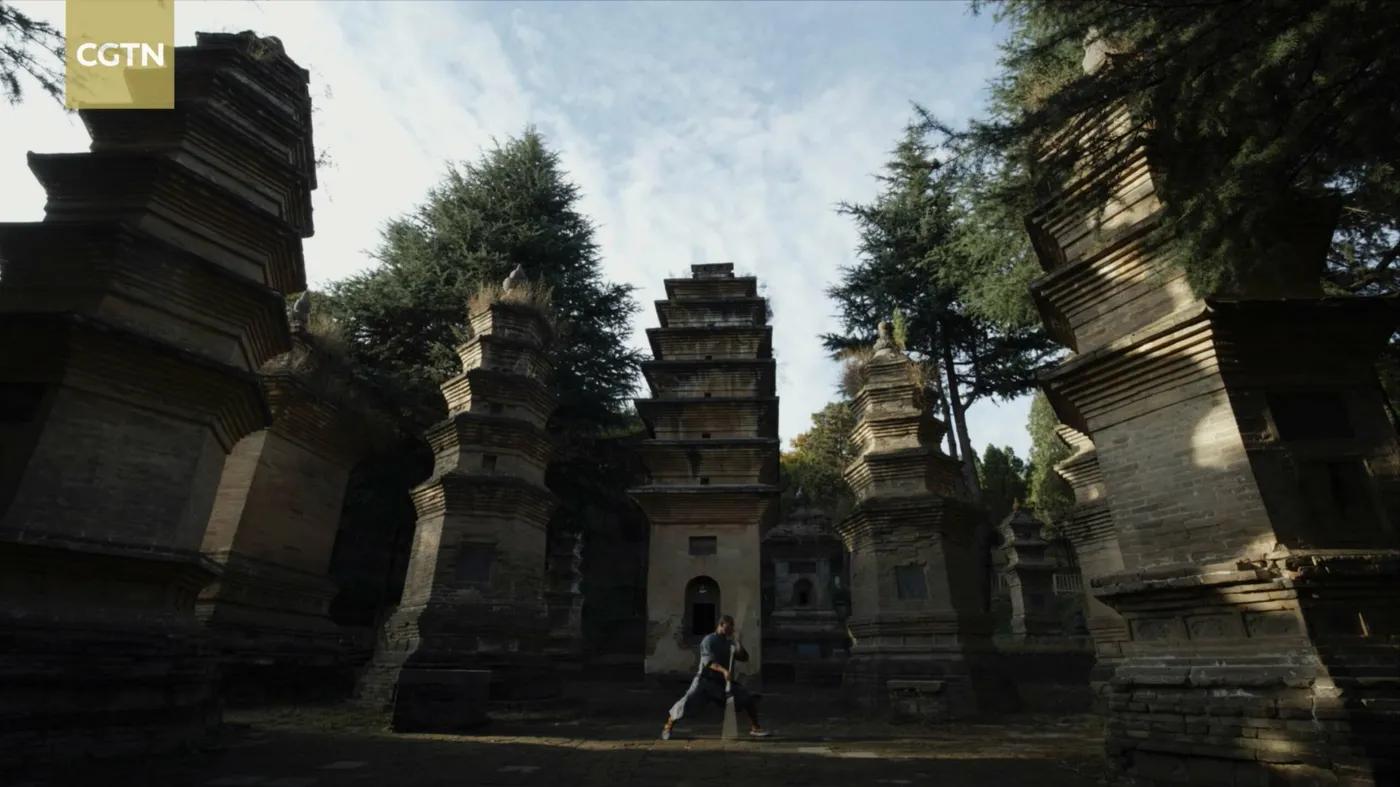
The Shaolin Monastery sits among mountains surrounded by trees. At 7:30am, sunlight can barely penetrate the dense canopy and enter the temple grounds. Between 8am and 5pm, the grounds are crowded with tourists and filming is impossible—so our actual shooting window was extremely limited. We needed to shoot interior night-for-day sequences in the evenings, but almost all buildings within the Shaolin Monastery have no electrical outlets, meaning we could only use small, battery-powered lighting fixtures: one Aputure 300D, one roll-flex light, and two rod lights. This severely limited lighting made night-for-day shooting extremely difficult. The MAVO LF's dual native ISO proved its worth here. Shooting inside the ancient main hall, we pushed ISO to 12800 and, working with the limited lighting we had, completed the indoor night-for-day sequences—achieving remarkably clean images.
____
The warrior monks told me that in previous productions, they had always been asked to slow down their staff movements to accommodate the cameras. But the results were often unsatisfactory—once you slow down the movements, the three-section staff sags and bends. A properly executed routine makes the staff look like a straight, rigid rod in the air. It was clear that shooting at 150–180fps would never achieve the effect I was after. The MAVO LF's 290fps slow-motion capability allowed me to complete this section of the shoot successfully! Furthermore, the MAVO LF's compact size and light weight meant that even I—someone with zero martial arts training—could easily swing the camera around to capture the monks' movements!
____
One more thing: for daytime exterior shots, we had only a single 5-in-1 reflector. The MAVO LF's high dynamic range let us achieve very satisfying images! Getting genuinely cinematic footage using purely natural light with no artificial lighting whatsoever—that was quietly thrilling. But I do have one complaint: false color is an essential feature for me to quickly adjust exposure and assist with lighting setup. The new EVF doesn't have false color, which means the one I bought is just collecting dust at home!
____
The MAVO LF truly demonstrated its excellence during this challenging shoot—I have to give it my sincere gratitude. It is genuinely perfect for documentary filmmaking. When a single piece of equipment allows you to achieve better shots under the same conditions and environment, that's something to be very pleased about. From showcasing Shaolin kung fu to capturing the daily life of warrior monks in the modern era, from high-contrast daylight exteriors to dim, narrow monastery interiors, the MAVO LF gave me effortless solutions. When a shoot becomes easier, more efficient, and more feasible simply because of a camera choice—why would you use anything else? I'm very glad I made the right purchasing decision.