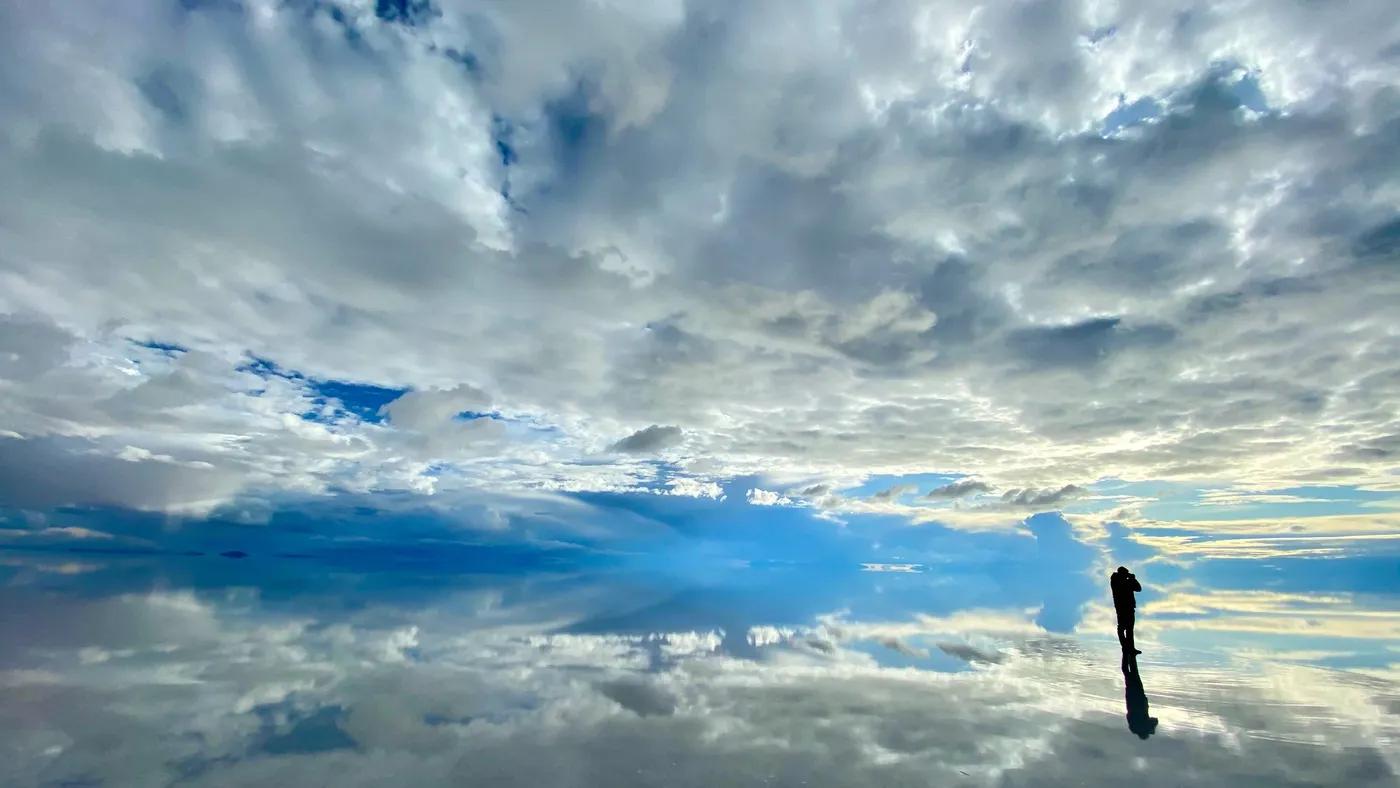
Interview with Award-Winning Documentary DP Toby Strong
Toby Strongis a renowned documentary cinematographer, multiple Emmy and BAFTA Award winner, who has collaborated with BBC, National Geographic, Discovery, and Netflix on legendary documentaries including Human Planet, Planet Earth II, and Blue Planet II. Gifted at capturing and sharing the world's beauty, Toby has shot on every continent. As a KinefinityMAVO LFowner, Toby discusses why he chose the MAVO LF and how it has helped him tackle challenges in extreme environments.
Q: Hello everyone. In this episode, we have invited renowned cinematographer Toby Strong. Welcome, Toby!
Toby: Good morning! Very happy to be on your show!
Q: Please briefly introduce your career background.
Toby: I've been working as a director of photography for over 20 years now. Like many of my contemporaries, I'm entirely self-taught. Although I studied engineering at university, I've always been very good at finding the beauty of the world and wanting to share it with others—so I led expeditions to beautiful places. Someone eventually connected me with camera work, and from then on I discovered I could use imagery to let more people experience the wonder of this world. Leveraging my engineering background, I successfully worked for a year in the Amazon jungle, building enclosures and setups for wildlife filming. Right around that time, I bought my first camera—a Paillard Bolex fully manual film camera. I then started learning, watching how to shoot, and taking on assistant work in productions. That's how I entered cinematography. I've kept moving forward, and today I primarily shoot wildlife and nature documentaries. I've been very fortunate to collaborate with BBC, National Geographic, Discovery, Netflix, and My Nature magazine on projects including Human Planet, Planet Earth II, Blue Planet II, Life Story, Seven Worlds One Planet, and One Strange Rock. My work typically involves shooting in the field, so I've been to every continent—most of which I love. For me, the most important thing is storytelling through visual language, but I also love new technology and want to apply it to my work. When shooting documentary films, there's usually extensive prep, long sessions with cameras and macro lenses, plus sliders, gimbals, drones, and jib arms. In short, I make full use of every available tool.
____
Q: That sounds fascinating. From your Vimeo videos, you've been to many remote places, and you mentioned having experience on every continent. So how do you pack and carry your camera for these shoots?
Toby: Let me talk about the shoots from the past few months. In late October 2019, I headed out with my MAVO LF. We began at nearly 5,500 meters altitude in Nepal. Then we went to Antarctica for filming under extremely extreme conditions. Sometimes we needed to shoot in minus 40 degrees Celsius. Going from minus 40 outdoors to plus 40 indoors—that kind of temperature swing is a very serious test for any camera. The final shoot of that journey was in Bolivia at 3,800 meters altitude, where I did extensive low-light and night shooting. From high-altitude night shoots to minus 40 or 50 in Antarctica, to desert shoots in 40 or 50 degree heat, to dust storms, rain, snow, and all kinds of extreme environments—my MAVO LF endured every single test.
Q: That's incredible!
Toby: I have to really emphasize my MAVO LF. When I first got it, I genuinely loved it—it has everything Kinefinity claims it does. I had a slight worry beforehand, because in some reviews people expressed concerns about its durability. So when I brought it to high altitudes and extreme temperature swings, my anxiety only grew. But the MAVO LF had zero issues—that made a deep impression on me. Even though I took good care to protect it, dust was inevitable, and occasionally it got rained or snowed on, yet it performed exceptionally throughout—reliable in any environment. When I went from minus 40 to plus 40 and back, it never failed once. That genuinely amazed me! Of course, we were very careful with such dramatic temperature changes, but the MAVO LF's toughness still can't be overlooked.
____
Q: In these shoots, how has the MAVO LF assisted your work?
Toby: The projects I work on have very high budgets. I can choose whatever camera and equipment I need for the job, but I specifically chose to purchase the MAVO LF—because it is genuinely astonishing! Absolutely incredible! Previously, in most situations I shot with RED and ARRI cameras, but their size and weight sometimes forced me to sacrifice creativity, because I simply couldn't move the camera quickly enough. The MAVO LF is different—it's elegant, and I love its aesthetic! It's genuinely tiny. I can pair it with the Ronin-S and shoot with one hand, moving through tall buildings, squeezing into tents, cars, and tight spaces. Putting a cinema camera with a 6K full-frame sensor on a handheld three-axis gimbal—no other camera can do that! In the MAVO LF I see an astonishing capability. When I brought it to northern Nepal, I was a little worried because the shoot required large telephoto lenses. I mounted the Canon 50-1000mm and MAVO LF on a gimbal—no issues at all, it sat there doing its job perfectly. Such a massive lens on such a tiny camera looks almost absurd, but the results were genuinely excellent. Whether car-mounted, on a Ronin-2, or on a jib arm, my MAVO LF adapted completely with zero problems. The compact body and sharp, clean images are exactly what I pursue—it handles challenges effortlessly in any environment.
Q: How do you typically judge exposure?
Toby: I've shot with many different cameras, so I trust my own eye. In most situations, I use the MAVO LF'sfactory 7-inch high-brightness monitorto judge exposure—it's dependable, and both my assistant and I keep a close eye on it.
____
Q: You also mentioned handheld shooting—can you talk about that?
Toby: Of course, I shoot handheld frequently. Without a gimbal, I use a simple rig I built myself—it's very low effort and perfect for long shooting sessions. As I've gotten more comfortable with the MAVO LF, I've found that for shorter takes I don't even need that rig—I can just shoot with the handle alone. This lets me take the MAVO LF to places where I previously couldn't shoot. It's so compact and light that I can carry it handheld and move wherever I need to go.
Q: Let's talk about camera settings.
Toby: One great thing about the MAVO LF is the dual native ISO—sensitivity can go from 800 up to 5000 and beyond. That's truly extraordinary! At ISO 5120, there is virtually no noise whatsoever. When shooting in high altitude and Antarctica where the light is very intense, I set ISO to 800—which brings me to the electronic ND mount adapter, which is really excellent! In bright light I can directly dial in ND stops on the fly—incredibly convenient and fast! I have a PL/EF adapterwith electronic NDandwithout electronic ND. For night shooting in Bolivia where light was very scarce, I simply set ISO to 5120. No complicated thinking required—just switch between the two ISOs.
Q: How do you handle wireless video on location?
Toby: Various ways. When I want a lightweight solution, I pair the MAVO LF with the Ronin-S and an Accsoon CineEye—this tiny transmitter works with both iPhone and iPad. When shooting on a tripod, I also use theKineBACK-W wireless backwith a DarkTower transmitter—this combination is fantastic. The transmitter card plugged into the body perfectly handles wireless image transmission. I tested the DarkTower in Antarctica—the signal strength was unbelievably powerful with virtually no latency. Truly impressive.
____
Q: Briefly describe your post-production workflow.
Toby: I don't have much to share about post-production workflow because we have a dedicated team that handles it—the footage goes through various post stages before the film airs. Of course, during pre-production I discuss the visual style with the director, and I also scout locations to understand what the monitor looks like before and after loading LUTs. Getting the 'feel' of a location beforehand lets me fully trust my eye during the shoot, and also gives me a sense of what I'm handing off to post. For me, that's just a working habit.
Q: Are there any special requirements when shooting these high-budget productions?
Toby: No special requirements, but standards are overall very strict—including adherence to NTSC color broadcast standards. And BBC requirements for content, image quality, codecs, compression ratios, and frame rates are famously high. Of course, rules have their limits, so we also make practical decisions about balancing production pace and quality depending on the length and difficulty of the shoot.
Q: Do you shoot slow-motion frequently?
Toby: In many shoots, because of synchronization requirements between multiple devices, we try to use clean multiples of the base frame rate—such as 25fps, 50fps, 75fps, 100fps. Generally my projects don't go above 75fps, though there are occasional exceptions. The MAVO LF reaches 75fps at full-frame 6K and up to 200fps at 2K—truly remarkable, just wonderful! I never have to worry about any 'special' shots. The MAVO LF supports preset shooting parameters, so I typically set up the six configurations I'll need before shooting to allow quick switching on set—this dramatically improves my efficiency.
Q: You mentioned that you often go to remote locations for long shoot periods. How many SSDs do you typically bring, and how do you manage your footage?
Toby: That's right—due to our subject matter, we go to remote places with no shops and sometimes no electricity. We run our own generator every two days to charge all the batteries. Fortunately the MAVO LF has very low power consumption, so I never worry about running out of battery. I carry twoKinefinity 500GB SSDsplus two Angelbird 500GB SSDs—four cards total. Four SSDs per day is completely sufficient for me. For the footage itself, we try to offload and create redundant backups every day—only very rarely do we go a day without offloading.
____
Q: Good. Final question—if you could add one new feature to the MAVO LF, what would it be? It can be more than one.
Toby: The MAVO LF is a fantastic camera—it has almost everything I want. I trust it completely during shoots, and it has never let me down. I keep emphasizing durability, especially when dealing with all kinds of extreme climates—so if Kinefinity could make it even more robust and reliable in extreme environments, that would be great. On the features side, since I never use peaking for focus, it would be great if the MAVO LF's monitor had an edge enhancement / sharpening function for monitoring. Whether the monitor is touchscreen doesn't particularly matter, but it would be a nice addition. I know the Kinefinity team is developing a new app—if the new app could support monitoring via iPad or iPhone over the body's Wi-Fi, that would be excellent. Many people would love to be able to use their existing devices as monitoring screens. But even without any of these features, the MAVO LF is still a superb camera. Fitting a 6K full-frame sensor into such a compact body is already extraordinary. I won't ask for features I'd rarely use, because it's already excellent—better than other cameras in resolution, frame rate, codecs, and image quality. I'm very satisfied with my MAVO LF.
Q: That's a wonderful way to conclude our interview today. Thank you, Toby.